
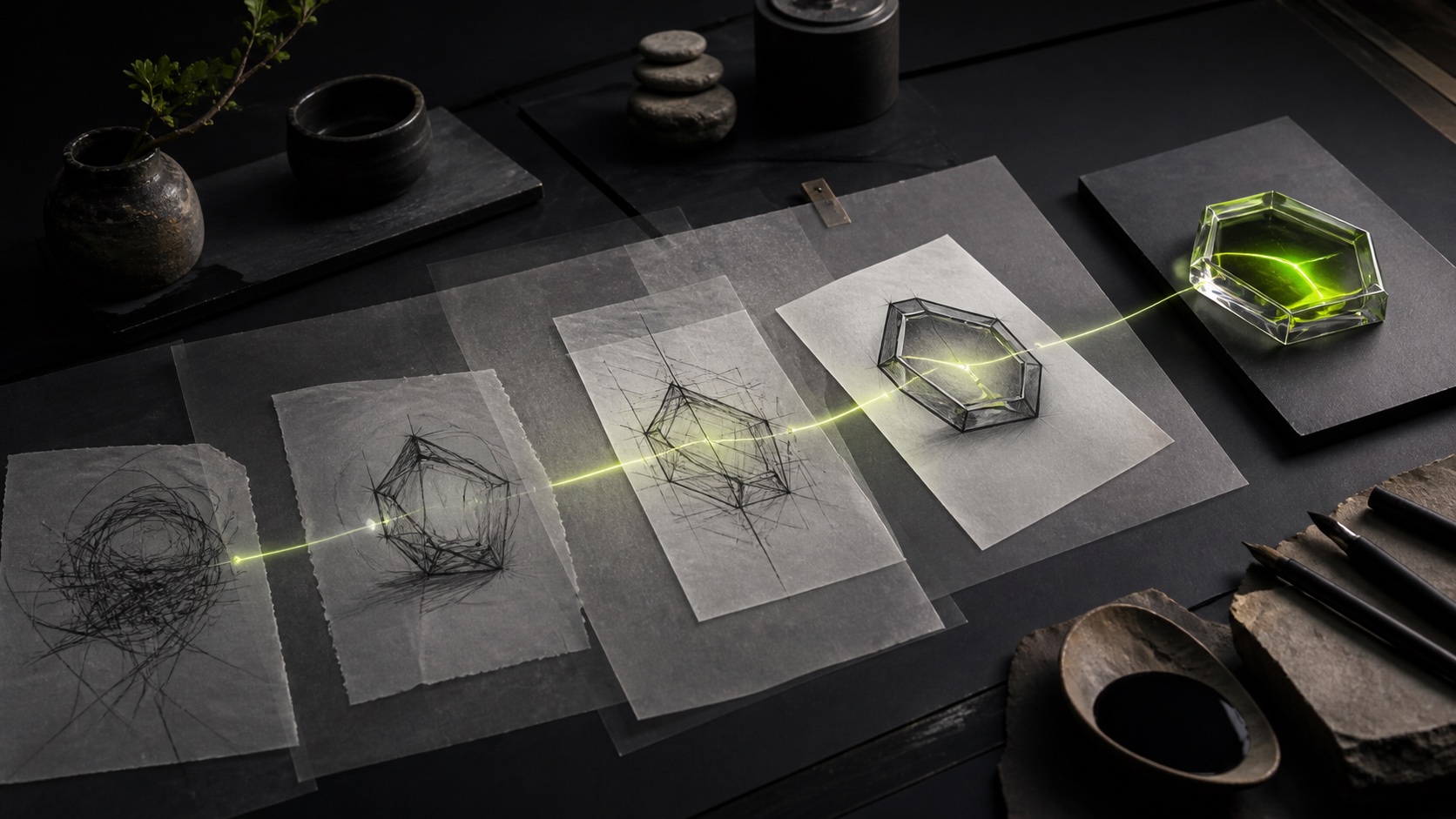
Early product ideas are rarely tidy. They arrive as a frustration, a collection of notes or a sentence that begins with “what if”. The first stage of a good build is not writing code. It is finding the useful core of the idea.
Define the outcome
I begin by describing what should be different for the person using the product. This keeps the conversation grounded in an outcome rather than a list of screens. A clear outcome also makes it easier to decide which features belong in the first version.
Map the smallest complete journey
The first release should be small, but it still needs to feel complete. I map the essential journey from entry to result: what a person sees, what they need to provide, what the system does and how success is confirmed.
This map exposes gaps before they become expensive. It also gives design and development one shared picture of the product.
Design with real content
Real names, realistic data and representative images reveal problems that placeholder content hides. The design should work with a long title, an empty state, a slow connection and a small screen—not only in a perfect desktop mock-up.
Build, test and learn
The first working version creates better questions. People can react to something concrete, and the team can observe where they hesitate or take an unexpected path. Those observations guide the next iteration.
A practical process does not remove ambition. It protects it. By proving the core journey first, there is a stronger foundation for the richer product that follows.